 Image 1 of 1
A small, slender, and distinct heirloom turnip historically grown on the Teltow plateau south of Berlin, the Teltower Turnip has been cultivated since at least the early 18th century. Its character comes directly from the poor, sandy-clay soils of the Teltow, where generations of farmers selected for flavor and resilience rather than size or uniformity. This landscape — and the turnip’s adaptation to it — gives the variety its exceptional flavor and unique form.
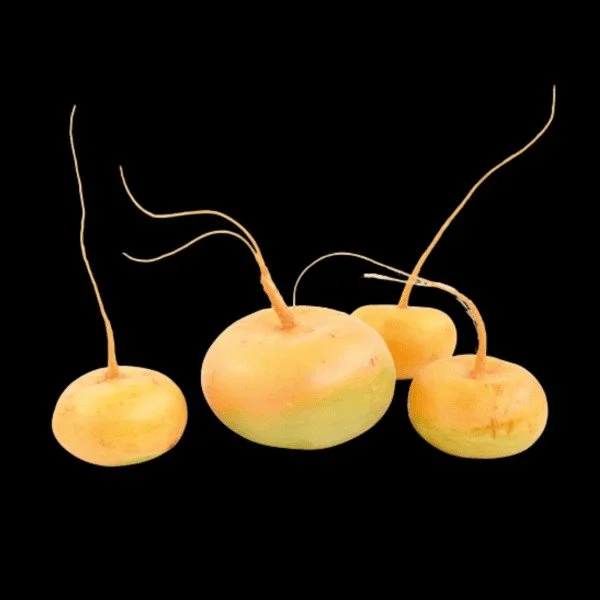
The roots are narrow and conical, averaging 6 cm long and 2–3 cm wide, with a pointed tip and delicate hair-fine side roots that appear in two subtle longitudinal rows. The skin ranges from grey-white to pale brown, never yellow, and may show faint cross-striations that can feel slightly textured to the touch.
Nutritionally, the Teltower Turnip differs from modern turnips:
Higher in natural sugars (especially sucrose)
Lower in water content
Lower in glucosinolates, giving it a complex, aromatic, lightly peppery flavor
The taste is zesty and aromatic — more akin to a young radish or mild mustard root than to a typical turnip. Historically, it was highly regarded in Berlin markets, especially in the late 18th and 19th centuries, appearing in household kitchens, taverns, and fine dining. Recipes for it appear in antique cookbooks, and the turnip was praised by Goethe, Immanuel Kant, and Theodor Fontane for both its flavor and its cultural rootedness.
As the crop was traditionally hand-sown, hand-weeded, and hand-harvested, it declined sharply with agricultural industrialization. For decades it survived mainly in small gardens and among dedicated seed stewards. Today, it remains rare, grown mostly by heritage growers who value flavor over yield and tradition over convenience.
Days to maturity: Fall / Winter harvest — sow in August, harvest October through early spring
Seeds per pack: 1/8-1/4 tsp of many small seeds
Germination rate: 92% 10/15/2025
The Teltower Turnip performs best in poor, sandy or clay-sand soils — rich soil can distort flavor and form.
Sow directly in August in full sun. Plant seeds shallowly (¼ inch deep) and thin to 3–4 inches apart. Consistent moisture during early growth helps establish roots; later, the plant tolerates cold and sparse conditions remarkably well.
Flavor is best after frost, when sweetness deepens.
This is a biennial, requiring overwintering to produce seed.
Select the best-formed roots in autumn, replant for seed in spring, and isolate from other Brassica rapa (such as turnips, napa cabbage, bok choy, and rapini) by at least ½ mile or hand-pollinate and bag.
Seeds are ready when pods dry to a pale tan. Store in a cool, dark, dry location. Seed remains viable 4–6 years or longer if frozen in the freezer.
A small, slender, and distinct heirloom turnip historically grown on the Teltow plateau south of Berlin, the Teltower Turnip has been cultivated since at least the early 18th century. Its character comes directly from the poor, sandy-clay soils of the Teltow, where generations of farmers selected for flavor and resilience rather than size or uniformity. This landscape — and the turnip’s adaptation to it — gives the variety its exceptional flavor and unique form.
The roots are narrow and conical, averaging 6 cm long and 2–3 cm wide, with a pointed tip and delicate hair-fine side roots that appear in two subtle longitudinal rows. The skin ranges from grey-white to pale brown, never yellow, and may show faint cross-striations that can feel slightly textured to the touch.
Nutritionally, the Teltower Turnip differs from modern turnips:
Higher in natural sugars (especially sucrose)
Lower in water content
Lower in glucosinolates, giving it a complex, aromatic, lightly peppery flavor
The taste is zesty and aromatic — more akin to a young radish or mild mustard root than to a typical turnip. Historically, it was highly regarded in Berlin markets, especially in the late 18th and 19th centuries, appearing in household kitchens, taverns, and fine dining. Recipes for it appear in antique cookbooks, and the turnip was praised by Goethe, Immanuel Kant, and Theodor Fontane for both its flavor and its cultural rootedness.
As the crop was traditionally hand-sown, hand-weeded, and hand-harvested, it declined sharply with agricultural industrialization. For decades it survived mainly in small gardens and among dedicated seed stewards. Today, it remains rare, grown mostly by heritage growers who value flavor over yield and tradition over convenience.
Days to maturity: Fall / Winter harvest — sow in August, harvest October through early spring
Seeds per pack: 1/8-1/4 tsp of many small seeds
Germination rate: 92% 10/15/2025
The Teltower Turnip performs best in poor, sandy or clay-sand soils — rich soil can distort flavor and form.
Sow directly in August in full sun. Plant seeds shallowly (¼ inch deep) and thin to 3–4 inches apart. Consistent moisture during early growth helps establish roots; later, the plant tolerates cold and sparse conditions remarkably well.
Flavor is best after frost, when sweetness deepens.
This is a biennial, requiring overwintering to produce seed.
Select the best-formed roots in autumn, replant for seed in spring, and isolate from other Brassica rapa (such as turnips, napa cabbage, bok choy, and rapini) by at least ½ mile or hand-pollinate and bag.
Seeds are ready when pods dry to a pale tan. Store in a cool, dark, dry location. Seed remains viable 4–6 years or longer if frozen in the freezer.